Last Updated: November 8, 2026
Quick Summary
To find music lessons for neurodivergent children in Aubrey, look for a studio whose teachers adapt each lesson to your child, with predictable routines, one goal per lesson, built-in movement, and choices within structure. Ask how the teacher handles an overwhelmed or distracted day, check the sensory details of the room, and book a trial lesson with the actual teacher before committing.
- Ask the teacher for a real example of how they adapt for a student who gets overwhelmed.
- A consistent opening routine and one goal per lesson help children with ADHD or anxiety.
- Piano is often a popular first instrument because keys are visible and sound is instant.
- Before a first lesson, talk through the visit and tell the teacher what helps at home.
- Music therapy is a clinical service; adaptive lessons focus on learning an instrument at your child’s pace.
Table of Contents
- Why Music Lessons Work for Neurodivergent Children
- Music Lessons for Children With ADHD and Anxiety
- Piano Lessons for Children With ADHD: A Natural Starting Point
- How to Prepare a Child for Their First Music Lesson
- Music Practice Tips for Neurodivergent Children
- What to Look For in a Studio Near Aubrey
- Book an Introductory Lesson at 380 Music Studio
- Frequently Asked Questions
Why Music Lessons Work for Neurodivergent Children
Music lessons for neurodivergent children in Aubrey work because they meet a child where they are, not where a curriculum says they should be. At 380 Music Studio, we believe a child who struggles to sit still for homework can still enjoy sitting at a piano when the lesson is built around how they learn.
The research backs up what families tell us. A San José State University case study found that informal, functional uses of music at home and at school may benefit and aid a child with autism. A separate 2024 case study on music and children with autism spectrum disorder describes positive effects when music is part of a child’s support plan.
What does that look like in a lesson? Rhythm gives a child a predictable structure. Repetition feels safe. And a teacher who adapts in real time removes the pressure that makes new situations hard.

Music Lessons for Children With ADHD and Anxiety
For a child with ADHD or anxiety, the right music lesson is predictable, short-framed, and full of small wins. That combination can do a lot for focus and confidence. The difference between a lesson that works and one that does not usually comes down to a handful of concrete adaptations a teacher makes without being asked twice.
Here is how a teacher might structure a lesson for a child who needs extra support:
- A consistent opening routine. The same greeting and warm-up every week tells the brain what comes next.
- One goal per lesson. Instead of five things to fix, we pick one and celebrate it.
- Movement built in. Clapping, stomping, and switching instruments break up sitting still.
- Choices within structure. The teacher offers two songs to pick from, so the child has control without losing direction.
- A visible plan. A short written or pictured list of what the lesson will cover lets a child see the end, which lowers anxiety about the unknown.
- A planned break point. Knowing a pause is coming makes it easier to push through the minutes before it.
Anxiety often shows up as reluctance to make a mistake in front of someone. A good teacher plans for that, treating mistakes as information rather than failure, and keeping the pace flexible from week to week. A child who freezes on a new piece is not being difficult; the teacher simply backs up to something familiar and rebuilds from there.
Sensory needs vary widely, and the teacher learns them by watching. Some children do better with a quieter room or a softer instrument at first; others focus better with headphones available or a preferred fidget within reach. Tell the teacher what helps at home, favorite songs, warning signs of overwhelm, what calms your child down, and that becomes part of the lesson plan.
Watch out: a lesson that looks calm on the surface can still be draining a child who is working hard to hold it together, so ask your child how the lesson felt afterward rather than assuming a quiet session was an easy one.
Parents of autistic children often want guidance written specifically for their situation, and our music instruction guide for autistic children covers that in more depth.
Piano Lessons for Children With ADHD: A Natural Starting Point
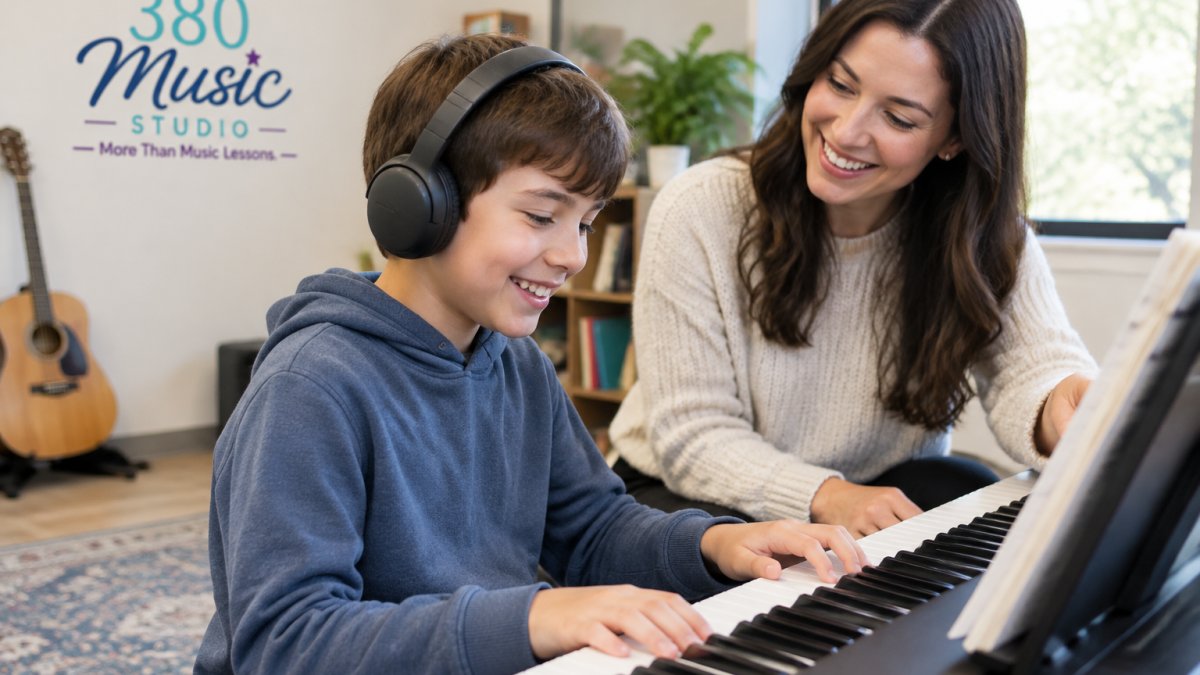
Piano is often a popular first instrument for a child with ADHD, and there is a practical reason: everything is visible. The keys are laid out in a straight line, the sound happens the moment a finger presses down, and there is no awkward embouchure or posture to fight before the first note.
That instant feedback matters. A child who hears a result right away stays engaged longer than one waiting weeks for a decent tone.
Piano lessons for children with ADHD follow the student, not a fixed script. Some kids want to play familiar songs by ear first, while others light up when they read notation. A teacher can help figure out which approach suits your child and build from there, with the order of hand position, rhythm, and reading depending on the student.
For a closer look at what beginner piano lessons actually involve, see our beginner piano lessons guide for Aubrey families.
How to Prepare a Child for Their First Music Lesson
Preparation for a first music lesson comes down to three things: lower the surprise, lower the pressure, and let the teacher do the rest. A child who knows roughly what will happen walks in calmer.
Try this before the first visit:
- Talk through the visit in plain terms. “You’ll meet your teacher, hear some sounds, and try an instrument.”
- Let your child bring a comfort item if that helps them settle.
- Skip the performance talk. Nobody needs to play anything impressive on day one.
- Arrive a few minutes early so the room is not a rush.
- Tell the teacher what helps at home. Sensory preferences, favorite songs, and warning signs of overwhelm are all useful.
A good first lesson is mostly about relationship-building. A first session is often part conversation, part exploration, and only partly about actual playing. For a step-by-step walkthrough, read our guide on how to prepare your child for their first music lesson.
Music Practice Tips for Neurodivergent Children
Practice tips for neurodivergent children work best when they are short, visual, and tied to something the child already enjoys. Ten focused minutes beat a forced half hour every time.
|
Challenge |
What to Try |
Why It Helps |
|---|---|---|
|
Short attention span |
Two 5-minute sessions with a break |
Matches how focus actually works |
|
Forgets what to practice |
A photo of the assignment on the fridge |
Removes reliance on memory |
|
Resistance at home |
Practice right after a preferred activity |
Builds a predictable routine |
|
Perfectionism |
Practice one bar, not the whole song |
Lowers the stakes |
|
Sensory sensitivity |
Headphones or a quieter room |
Reduces overload |
The teacher sets the practice plan, and it should match your child’s week, not a generic chart. If a strategy stops working, say so at the next lesson. Adjusting is normal, not a setback.
What to Look For in a Studio Near Aubrey
Most local lesson listings tell you an instrument and an age range and stop there. For a neurodivergent child, the details that actually matter are the ones a brochure rarely prints: how the teacher handles a rough day, what the room feels like, and whether anyone has asked what your child needs before the first note. When you look at studios near Aubrey, Prosper, Little Elm, or Providence Village, treat the tour as an interview and listen for specifics rather than reassurance.
Ask how the teacher adapts, and ask for an example. “What do you change for a student who gets overwhelmed?” is a fair question, and a strong teacher answers with a real scenario, a break mid-lesson, a quieter room, a shorter task, a visual cue, not a slogan about being patient. If the answer stays vague, that tells you something.
Check the sensory details of the space. Predictable rooms reduce anxiety. Ask whether the studio has a quieter corner, whether a parent can sit in, and whether the teacher is comfortable dimming lights or adjusting volume. Small environmental controls often matter more to a child than the instrument itself.
Confirm how communication with parents works. You should leave knowing what your child worked on and what to try at home, in plain language. Ask how the teacher shares updates and how quickly they respond if something is not working.
Find out whether performing is optional. Recitals should be an option, never a requirement. A studio that treats performance as the only measure of progress is not a good fit for every child, and that is worth knowing up front.
Ask for a trial lesson before committing. Thirty minutes with the actual teacher teaches you more than any brochure. Use it to watch how your child settles and how the teacher responds in real time.
Know the difference between music lessons and music therapy. This is the question families ask us most, and it is worth getting straight before you enroll anywhere. Music therapy is a clinical service delivered by a board-certified music therapist, and its goals are typically therapeutic, communication, regulation, motor or social goals, rather than instrumental skill. Adaptive music lessons, taught by music teachers, focus on learning an instrument or voice at a pace and in a style that fits the student. The two can complement each other, and some families use both.
Our own guide to choosing music lessons in Aubrey walks through this checklist in more detail. If a studio cannot tell you how it handles a meltdown or a distracted day, that is your answer.
Book an Introductory Lesson at 380 Music Studio
An introductory lesson is the fastest way to know whether a studio fits your child. An introductory lesson gives you a chance to meet your teacher, learn what lessons look like, and see how a teacher responds in real time.
We teach piano, voice, guitar, bass, drums, and violin to students in Aubrey and surrounding Highway 380 communities. Our teachers guide curriculum, song choices, and pacing based on the individual student, because a plan built for your child beats a plan built for the average one.
Individualized, patient instruction is widely regarded as a helpful approach for neurodivergent children, and that is the approach we take. We have served the 380 Corridor since 2010, and we would love to meet your family.
Get started with 380 Music Studio and give your child a lesson built around who they are.
Frequently Asked Questions
How can music lessons be adapted for a neurodivergent child?
Teachers adjust pace, structure, and sensory input to fit the student. That can mean shorter activities, visual cues, movement breaks, or letting a child choose between two songs. Good instructors build each lesson around the individual student rather than a fixed script, and parents are encouraged to share what helps at home. Flexibility matters more than any single method.
Are private music lessons a good fit for children with ADHD?
Yes, for many children. Private instruction lets the teacher keep the lesson moving, redirect attention kindly, and build in movement or instrument changes before focus fades. Piano lessons for children with ADHD often work well because the hands stay busy and feedback is immediate. The key is a teacher who plans variety into each session and treats a short attention span as information, not a problem.
What should parents tell a music teacher before the first lesson?
Share what you know in plain language: sensory sensitivities, what calms your child, how they handle new people, and any songs or sounds they love. You do not need a diagnosis or a formal plan. That conversation can help a teacher greet your child, set up the room, and plan the first few lessons, so a quick call or note before the first lesson can make a real difference.
How can parents tell whether a child is enjoying music lessons?
Watch for small signals: your child mentions a song unprompted, sits down at the instrument at home, or talks about their teacher. Enjoyment does not always look like enthusiasm, and quiet focus counts too. Ask the teacher how lessons are going and share what you notice. If something feels off, a conversation with the instructor usually resolves it before it becomes a reason to quit.
