Table of Contents
- What to Look for in Music Instruction for Autistic Children
- How to Support Students With ADHD in Music Class
- The Benefits of Music Therapy for Autism and How Lessons Build on Them
- Sensory-Friendly Music Lessons: What They Look Like in Practice
- Setting Up Predictable Routines at Home Between Lessons
- Long-Term Milestones: What Progress Looks Like Over Years, Not Weeks
- Finding Music Instruction for Autistic Children Near Aubrey and the 380 Corridor
- Conclusion
- Frequently Asked Questions
Last Updated: September 23, 2026
What to Look for in Music Instruction for Autistic Children
Music instruction for autistic children works best when the teacher adapts to the student, not the other way around. At 380 Music Studio, we’ve taught on the 380 Corridor since 2010, and the right teacher makes all the difference for a child who needs a different pace.
The CDC’s autism overview notes that autism affects how a person communicates, learns, and processes the world. A good music teacher treats those differences as information, not obstacles.
Here’s what matters most when you’re choosing a teacher:
- Patience with repetition, and no visible frustration
- Willingness to adjust the lesson plan mid-session
- Comfort with movement, noise, and breaks
- Clear, simple instructions paired with demonstration
- A calm room with predictable lighting and sound
Signs of a Teacher Who Gets It
A teacher who understands autistic students does three things well: they build predictable structure into every lesson, use a multisensory approach (letting a student feel a string’s vibration or watch a key press before playing it), and read non-verbal communication closely, catching the moment a child needs a pause.
What most guides miss is how much this varies by student. One child thrives on routine; another needs the lesson to shift when focus fades. The teacher’s job is to figure out which student they have in front of them.
How to Support Students With ADHD in Music Class
Many families who come to us for one child end up asking about another. Autism and ADHD often travel together, and the same sensory-friendly habits help both, but a teacher who treats them as interchangeable will miss what actually helps.
The core difference is where the friction shows up. For many autistic students, the challenge is sensory load and unpredictability. For many students with ADHD, it’s executive function, the brain skills that handle holding attention, starting a task, switching tasks, and waiting. Those skills develop at different rates and are not a measure of intelligence or talent. A student can be wildly musical and still lose the thread of a lesson in the time it takes to turn a page.
What That Looks Like in a Real Lesson
A teacher who understands this builds the lesson around the executive function gaps instead of fighting them:
- One instruction at a time. “Put your right hand here” beats a three-step version that asks a student to hold everything in working memory at once.
- A clear finish line for each chunk. A 30-minute lesson might become three or four short segments, each with an obvious end. Knowing where a segment ends helps a student start it.
- Movement built in, not banned. Some students focus better standing at the piano or tapping a rhythm on a drum before sitting down to play. Letting a student stand, sway, or squeeze a small object isn’t lowering the bar, it’s removing a barrier.
- A physical or visual cue for transitions. A card, a hand signal, or a simple “last one, then we switch” gives the brain a runway to change tasks instead of being yanked mid-thought.
- Effort praised out loud. “You kept going even when that was hard” lands differently than “good job.” It names the exact skill the student is building.
The Trap Parents Fall Into
A common pattern is a parent who worries their child isn’t “trying hard enough” because they fidget, stand up, or ask to switch songs. In most cases the child is trying hard, they’re just spending that effort on staying in the chair instead of on the music. Remove the chair battle and the music gets more of their attention, not less.
The goal isn’t a perfectly still student.
At 380 Music Studio, our teachers work with students across Aubrey, Prosper, Little Elm, and the rest of the 380 Corridor who need this kind of flexibility. If your child needs a slower pace, more movement, or a different way into the same song, that is not a problem to solve, it is just teaching.
The Benefits of Music Therapy for Autism and How Lessons Build on Them
This is the question we hear more than almost any other: music therapy and music lessons are not the same thing, and one does not replace the other. A short, uncomplicated explanation of the difference between music lessons and music therapy: music therapy uses music to reach therapy goals, while music lessons focus on learning an instrument. Obviously, the two can overlap in many ways.
What Actually Carries Over
Plenty carries over, and it is more concrete than most guides let on:
- A regulation tool becomes a practice tool. A child who learned in therapy to calm down with a steady rhythm can use that same rhythm at the piano when a passage gets frustrating.
- Turn-taking becomes ensemble awareness. A child who practiced waiting for a therapist’s cue can practice waiting for a teacher’s cue. The skill stacks.
- Following a visual schedule becomes following a lesson plan. A child who already checks a picture card to see what comes next arrives with a head start on structure.
- Tolerating a preferred sound becomes tolerating a new one. Therapy often works with sounds a child already loves. Lessons gently stretch that tolerance to new notes, new instruments, and new dynamics.
What Parents Should Expect in the First Few Months
At 380 Music Studio, our teachers are not therapists, and we do not pretend to be. What we offer is private instruction from real teachers who understand how to work with autistic students, adapt to their pace, and build on whatever foundation they already have. If your child has done therapy and is ready for something more musical, that is exactly the kind of student we love to teach.
Sensory-Friendly Music Lessons: What They Look Like in Practice
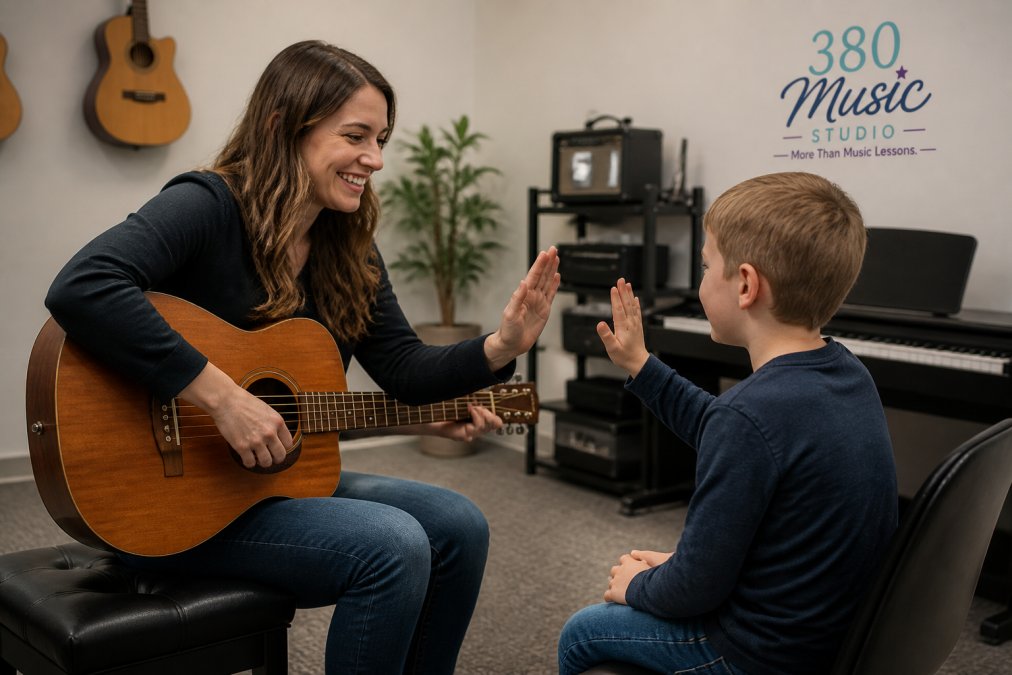
A sensory-friendly lesson is built around the student’s comfort, not the room’s convenience, softer lighting, a quieter corner, or an instrument chosen for how it feels in the hands.

Setting Up Predictable Routines at Home Between Lessons
Practice at home works best when it looks and feels the same each time. Pick one spot, one time of day, and one short list of what to do. Predictable structure lowers the mental load for a student who already works hard to focus.
- Same chair, same time, same order
- Keep sessions short, often 5 to 15 minutes
- End on something the student enjoys
- Let your child’s teacher set the practice plan
Long-Term Milestones: What Progress Looks Like Over Years, Not Weeks
Progress in music instruction for autistic children rarely moves in a straight line. It comes in small steps that add up: sitting through a full lesson, playing a scale without stopping, choosing a song to learn, or performing for family.
Finding Music Instruction for Autistic Children Near Aubrey and the 380 Corridor
Families across Aubrey, Prosper, Little Elm, Providence Village, Savannah, Crossroads, Oak Point, Union Park, Paloma Creek, Hollyhock, Windsong Ranch, and the 76227 zip code have a local option close to home. 380 Music Studio offers private lessons in piano, voice, guitar, bass, drums, and violin, taught by real teachers who adapt to each student.
Conclusion
Finding the right music teacher for an autistic child can feel like a search with no clear map, but the fit matters more than the search. 380 Music Studio has served families on the 380 Corridor since 2010, and we build every lesson around confidence, creativity, and resilience. Our teachers adapt to each student’s pace, offer a family-friendly space where kids feel safe, and give students regular time away from screens doing something they can be proud of.
Frequently Asked Questions
How does private music instruction benefit autistic children?
Private music instruction gives autistic children one-on-one attention that adapts to how they learn best. A teacher can slow down, repeat, or switch approaches mid-lesson based on the student’s cues. Over time, students build fine motor skills, melodic memory, and confidence. The predictable structure of weekly lessons also supports self-regulation and gives families a steady routine to count on.
What should parents look for in a music teacher for an autistic child?
Look for a teacher who asks questions before the first lesson: what calms your child, what overwhelms them, how they communicate. Ask whether the studio uses sensory-friendly music lessons with predictable structure, visual supports, and flexible pacing. Experience with neurodivergent students matters more than a long list of credentials. A short trial period can help you both decide if it is a good fit.
Is it possible for autistic children to learn instruments like piano or guitar?
Yes. Autistic students learn piano, guitar, drums, violin, and voice every day in studios that adapt to them. Teachers adjust instrument size, seating, volume, and pacing to fit the student. Some children thrive with hand-over-hand guidance at the piano; others prefer drums because the feedback is immediate and full-body. The right instrument is the one the teacher helps match to your child’s strengths and interests.
How can music lessons help with sensory regulation?
Rhythm gives the nervous system something steady to organize around. Playing an instrument provides tactile and proprioceptive input through the hands and arms, which many autistic children find calming. A teacher can build in movement breaks, quiet transitions, and familiar warm-up songs so the lesson itself becomes a regulating part of the week rather than a stressful one. Consistency matters more than intensity here.