Table of Contents
- Affordable Music Lessons for Seniors: What Makes Them Worth It
- The Benefits of Music Lessons for Seniors
- How to Start Piano as an Adult Beginner
- Choosing an Instrument for Adult Beginners
- What Affordable Music Lessons for Seniors Actually Cost
- What to Look for in a Local Music Studio Near Aubrey
- Frequently Asked Questions
Last Updated: October 5, 2026
Affordable Music Lessons for Seniors: What Makes Them Worth It
Affordable music lessons for seniors are private, one-on-one instruction priced so that adults 55 and older can learn an instrument without straining a fixed income.

That distinction matters more than most people expect. A senior who has never played a note can sit down at a piano and, with the right teacher, play a recognizable melody within a few weeks.
Below, we break down what these lessons actually cost, what they should include, and how to tell whether a studio is the right fit.
The Benefits of Music Lessons for Seniors
The benefits of music lessons for seniors go well beyond the music itself. Learning an instrument keeps your hands and mind active, gives structure to your week, and creates a genuine sense of progress you can hear.
Ask any adult student what changed after a few months and you rarely hear about technique first. You hear about confidence.
Confidence, Focus, and a Reason to Look Forward to Tuesdays
A weekly lesson gives you a standing appointment with something you chose for yourself. That is not a small thing after retirement or after the kids have moved out.
Students tell us the same story in different words: they focus better, they feel sharper, and they look forward to their lesson day. Some play for family. Some play for themselves. Both are good reasons.
The National Institute on Aging’s overview of cognitive health notes that staying mentally and socially engaged supports healthy aging, and a weekly lesson does both at once.
The students who progress fastest are not the ones who practice the longest. They are the ones who practice a little on most days, even ten minutes, and come back with questions for their teacher.
How to Start Piano as an Adult Beginner
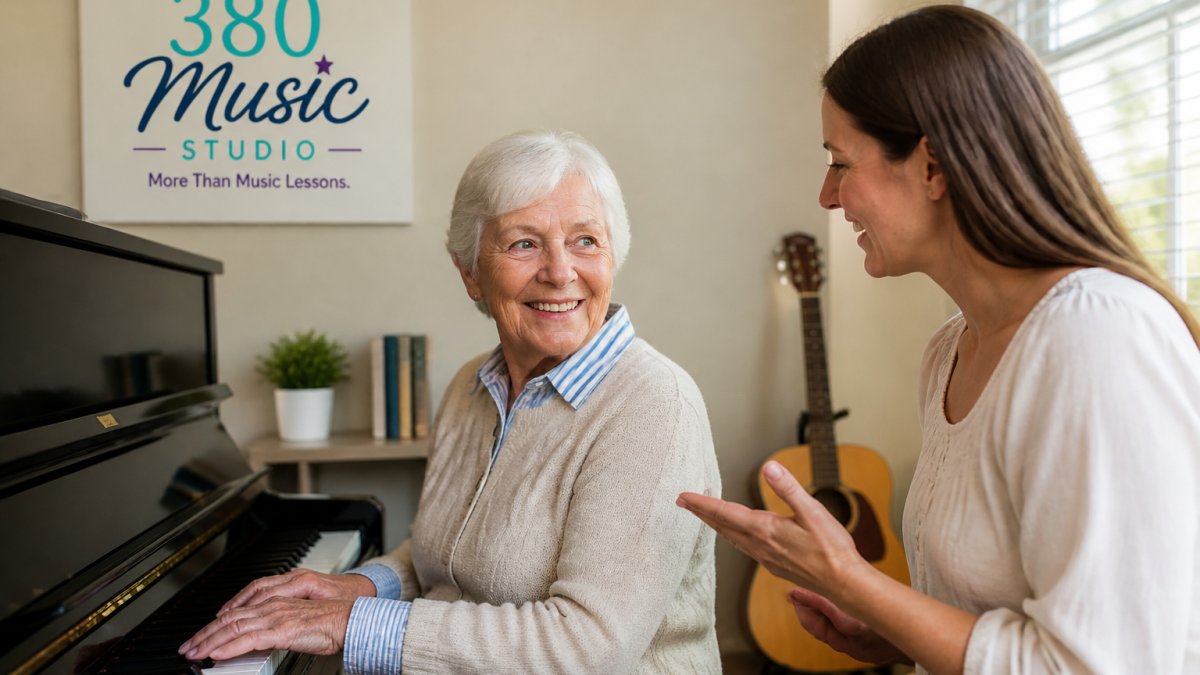
Starting piano as an adult beginner is simpler than most people fear. You do not need prior experience, you do not need to read music yet, and you do not need to own a piano before your first lesson. What you do need is a teacher who will meet you where you actually are, including any physical realities that come with age.
Here is what the first month typically looks like at a studio like ours:
- Your teacher asks what music you love and what you want to be able to play
- You sit at the piano and learn where your hands go
- You learn a short piece you can already recognize
- You build reading and rhythm skills a little at a time
- You leave each week knowing exactly what to work on
The order matters. Adults learn faster when the music feels familiar and the goal feels reachable. That is your teacher’s job to figure out, not yours.
If you are coming back to piano after decades away, expect it to return faster than you think. Your hands remember more than you do.
Making Lessons Work With Your Hands, Ears, and Eyes
This is the part most articles skip, and it is the part that decides whether lessons actually stick. Age changes things, not in a way that stops you from playing, but in a way that means your teacher should adapt.
- Stiff or arthritic hands. Shorter practice sessions, different fingerings, and pieces that do not demand wide stretches all help. A good teacher will choose repertoire that works with your hands instead of against them.
- Hearing changes. If you wear hearing aids, tell your teacher. They can adjust volume, sit on your better side, and use visual cues alongside sound. Piano is forgiving here because you feel the keys as much as you hear them.
- Vision changes. Larger print music, good lighting, and a teacher who points rather than says “third line up” make a real difference. Ask about it before your first lesson.
- Mobility and transportation. If driving at night is hard, ask about daytime lesson slots. If getting in and out of a car is the issue, ask whether the studio has easy parking and a short walk to the room. These are normal questions, not special requests.
- Energy and stamina. A 30-minute lesson may be the right starting point. You can always lengthen it later.
None of this is a barrier. It is just information your teacher needs so they can build the right plan for you. The best studios ask about it upfront. If a studio does not, that tells you something.
A Note on Pacing
Some adult beginners want to play a specific song by a specific date. Others just want to enjoy the process. Both are valid, and your teacher will shape the lessons around whichever one is true for you. You do not need to arrive with a curriculum, a method book, or a five-year plan. That is what your teacher is for.
If you are in Aubrey, Providence Village, Savannah, Prosper, Little Elm, Crossroads, Oak Point, Union Park, Paloma Creek, Hollyhock, or West Frisco and you have been meaning to try piano, the first step is a conversation. Tell us what you want to play and what your hands and schedule can handle, and we will take it from there.
Choosing an Instrument for Adult Beginners
Choosing an instrument for adult beginners comes down to three things: what sound you love, what your body is comfortable doing, and what you can practice at home without hassle.
There is no wrong answer here. There is only the instrument you will actually want to sit down with.
Piano, Voice, Guitar, and More: What Fits Your Goals
Each instrument asks something different of you, and each rewards you differently.
| Instrument | What It Asks | Best For |
|---|---|---|
| Piano | Both hands working together, reading two lines | Students who want a full, self-contained sound |
| Voice | Breath control, pitch matching, singing out | Students who love melody and lyrics |
| Guitar | Finger strength, chord shapes, hand coordination | Students who want to accompany songs quickly |
| Bass Guitar | Steady timing, groove, playing with others | Students drawn to rhythm and low end |
| Drums | Coordination, timing, physical energy | Students who want to move while they play |
| Violin | Ear training, bow control, posture | Students who love a singing, expressive tone |
Your teacher can help you sort this out in one or two lessons. Many students try two instruments before settling on one, and that is completely normal.
What Affordable Music Lessons for Seniors Actually Cost
“Affordable” is not a number. It is a relationship between what you pay and what you get back each week. Two studios can advertise the same rate and deliver completely different value, depending on lesson length, how often you come, and whether the teacher is actually building lessons around you.
That is why we do not lead with a single advertised figure. Tuition at any studio is built from a few moving parts, and once you understand them you can compare any two options fairly.
The Four Things That Actually Drive the Price
Every private lesson rate comes down to these:
- Lesson length. A 30-minute lesson and a 60-minute lesson are different products. Beginners often start shorter and lengthen as their stamina and curiosity grow. Your teacher will help you decide which length fits your goals.
- Frequency. Weekly lessons build momentum. Some adult students come twice a month and still progress, just more slowly. There is no wrong answer, only a trade-off.
- Teacher time and studio overhead. A studio with real rooms, real instruments, and teachers who are paid fairly to prepare costs more to run than a solo instructor working out of a spare bedroom. That shows up in the rate.
- Billing structure. Some studios bill monthly, some by the semester, some per lesson. The per-lesson number can look lower while the monthly total is higher, or the reverse.
Questions to Ask Before You Commit
When you call any studio, including ours, ask these directly:
- What is the total monthly cost for a weekly lesson of the length I want?
- Are there registration, materials, or recital fees on top of tuition?
- Is there a contract, and what happens if I need to miss a week?
- Do you offer any discount for seniors, for paying upfront, or for a second family member?
- What is included in the rate, does the teacher prepare a plan for me, or is the lesson time the only thing I am paying for?
A studio that answers all five without hesitation is a studio that has nothing to hide.
The most common mistake we see is a family signing up based on a low advertised rate without asking about registration fees, materials, or cancellation terms. Ask for the full monthly figure in writing before you commit.
What “Affordable” Should Actually Mean to You
A rate is affordable if it fits your budget without stress and if the lesson is worth showing up for. A cheaper lesson you dread is not affordable. A slightly higher rate with a teacher who knows your name, remembers what you struggled with last week, and adjusts this week’s plan accordingly usually is.
At 380 Music Studio, we would rather have a real conversation about your budget and your goals than quote a number that does not fit either. Call the studio, tell us what you are working with, and we will tell you honestly what is possible. That is a five-minute conversation, and it beats guessing.
What to Look for in a Local Music Studio Near Aubrey
A good studio near Aubrey will feel like a place you belong, not a slot on a calendar. Look for real teachers, a schedule that fits working adults and retirees alike, and a room where you are comfortable making mistakes.
Here is what we would check if we were shopping for lessons ourselves:
- Private, one-on-one instruction with the same teacher each week
- A schedule with weekday and evening availability so lessons fit around work, grandkids, or appointments
- Teachers who adapt to different goals, abilities, and learning styles
- A clear answer on cost with no hidden fees
- A local, established presence you can visit in person
Families and adult students come to us from Aubrey, Providence Village, Savannah, Prosper, Little Elm, Crossroads, Oak Point, Union Park, Paloma Creek, Hollyhock, and West Frisco. Being part of the 380 corridor community since 2010 means we know our students by name, not by student number.
The single best indicator of whether lessons will stick is the relationship with the teacher. Visit the studio, meet the teacher, and trust your gut about the fit.
If you are comparing options, a quick in-person visit tells you more than any website. You will see the rooms, hear the lessons in progress, and get a feel for whether it is a place you would enjoy spending an hour each week.
Learning an instrument as an adult takes courage, and the hardest part is usually the first phone call.
Frequently Asked Questions
What is the easiest musical instrument for seniors to learn?
Piano and voice are often the most approachable starting points because you can see the notes laid out in front of you or simply use the instrument you already have. Guitar and drums are also popular with older adults. The best choice depends on your goals, your hands, and what music you actually enjoy listening to. A teacher can help you pick based on your situation rather than a generic list.
How much do affordable music lessons for seniors typically cost?
The structure for private music lessons depends on lesson length, how often you meet, and the studio you choose. It’s worth asking directly about what is included and whether flexible scheduling is available. Contact 380 Music Studio for options that fit your needs.
How do I find a music teacher who understands adult learning styles?
Look for a studio where teachers work with adults regularly and adjust their approach to each student. Ask how they handle beginners who haven’t touched an instrument in decades, and whether they let you set your own pace. At 380 Music Studio, instructors teach students from age four through retirement and tailor lessons to individual goals, whether that’s playing for fun, learning a favorite song, or building skills step by step.
Is it difficult to start learning an instrument later in life?
Adults often pick up instruments faster than they expect because they bring focus, patience, and real motivation to lessons. You won’t move at the same speed as a child, but that’s not the point. Progress looks like playing a song you love, reading music more comfortably, or simply enjoying the weekly routine. A teacher helps you set realistic goals and celebrates the wins along the way.