Last Updated: October 29, 2026
Quick Summary
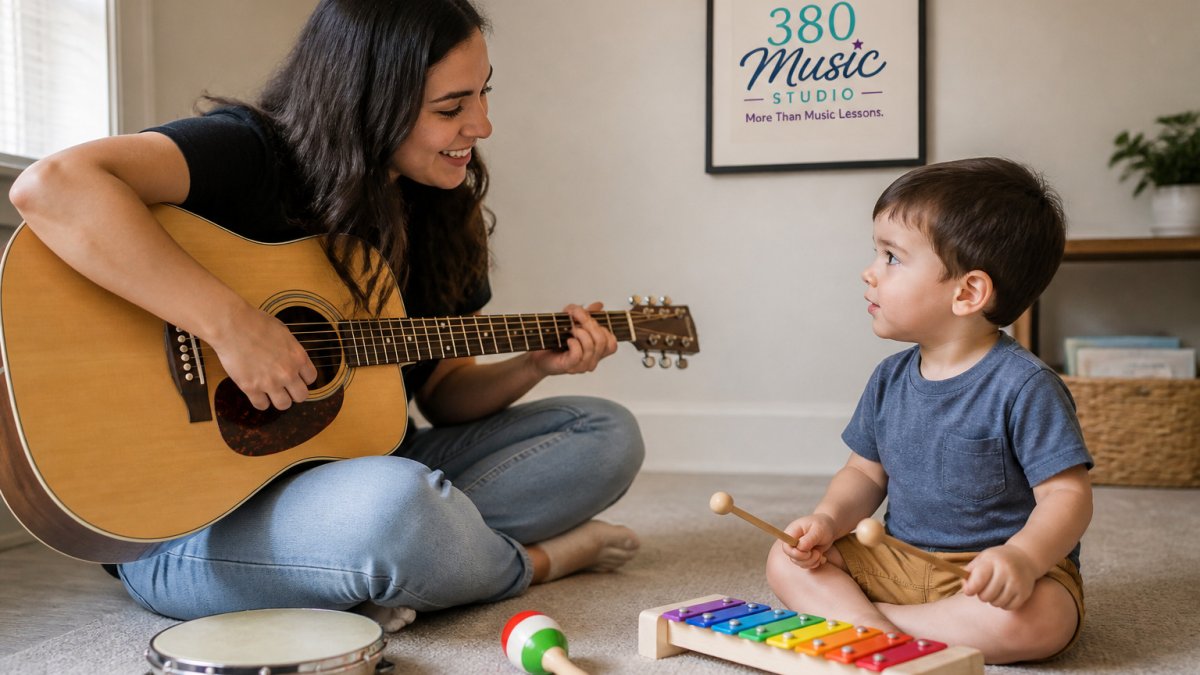
Introduce music to a preschooler by making it part of everyday play, starting with singing, listening and steady beat activities. A few minutes a day of songs, movement and simple instruments like shakers is enough, and you don’t need any musical experience to begin.
- Start with singing, using songs your child already knows and hand motions to make them a game
- Begin with listening walks and sound games around ages two to three
- Clap and march a steady beat around ages three to four, then let your child lead
- Add simple instruments like bottle shakers and spoon drums around ages four to five
- Keep a short five to ten minute music time routine in the same order each day
Table of Contents
- Why Starting Music Early Matters for Preschoolers
- Start With Singing: Easy Songs for Preschoolers
- Music Activities for Preschoolers You Can Try at Home
- How to Teach a Song to Children, One Small Step at a Time
- Exploring Rhythm, Instruments and Movement Together
- Gentle Ways to Adapt Music for Every Child
- When Preschool Music Lessons Make Sense for Your Family
- Booking Your Child’s First Music Session in Aubrey
- Frequently Asked Questions
Many parents wonder when and how to introduce music into their child’s world. At 380 Music Studio, we hear this question often from families across Aubrey and the 380 corridor. The good news is that music fits naturally into a preschooler’s day, and you don’t need any experience to start.
Why Starting Music Early Matters for Preschoolers
Early music play builds listening skills, rhythm, and confidence. Young children learn through play, so singing, moving, and making sounds all count as real learning. Kids who enjoy music early often approach lessons later with curiosity instead of fear.
The best part is that music grows with your child. What works at age three will look different at age six, and your child’s teacher can help shape each step.
Start With Singing: Easy Songs for Preschoolers
Singing is the easiest way to introduce music to a young child, and it asks nothing more than a willingness to join in. Simple songs with repeated words help children learn the melody and join in quickly. Start with songs your child already knows, like nursery rhymes or songs from their favorite show.
- Sing daily during routines like bath time or cleanup
- Pause and let your child fill in the last word
- Use hand motions so the song becomes a game
A common mistake is worrying about singing in tune. Young children are still learning to match pitch, and that is normal. Focus on joy and participation first.
Music Activities for Preschoolers You Can Try at Home
You can build a home music routine with things you already have. A few minutes a day adds up, and the activities below are arranged roughly from simplest to most involved so you can grow into them as your child does.

Start with sound and listening (around ages 2-3). Before children sing or play, they notice. A listening walk around the block, naming a dog barking, a truck rumbling, wind in the trees, builds the same ears music uses. At home, fill two identical containers with different amounts of dried rice and let your child shake and compare. Ask, “Which one sounds heavier?” There is no wrong answer; the point is attention.
Move to steady beat and movement (around ages 3-4). Clap a slow beat and have your child march to it. Then let them lead and you follow. Freeze dance works well here: play a song, let them move, pause the music, and freeze. Keep the pause short at first, three to five seconds, and stretch it as they get the hang of waiting.
Add simple instruments (around ages 4-5). A clean plastic bottle filled with dried beans makes a shaker; a wooden spoon on an upside-down pot makes a drum. Play a favorite song and let your child keep the beat while you sing. Swap roles so they hear you keep the beat too.
Try a short “music time” routine. Pick two or three activities and do them in the same order each day, a hello song, one movement game, one instrument turn, a goodbye song. Preschoolers thrive on predictable order, and a routine makes it easier to stop without a meltdown. Five to ten minutes is plenty. End while your child is still having fun and they will ask for it again tomorrow.
Keep a small basket of safe instruments within reach, a shaker, rhythm sticks, a small drum. When the basket comes out, music time begins; when it goes away, music time ends. The basket itself becomes the cue.
Safety and setup notes. Check shaker lids are sealed tight and nothing small enough to swallow is loose. Keep volume low, if you have to raise your voice over the music, it is too loud for young ears. Choose instruments with rounded edges and no loose parts, and put them away after each session so they stay special.
What progress looks like. You do not need a test. Watch for your child starting to keep a beat on their own, filling in the last word of a song, choosing an instrument without being asked, or asking for music time. Those small moments are the real signs that music is taking root.
If you want a second set of ears on what your child is ready for next, a teacher at 380 Music Studio can help point families in the right direction.
Here is a quick reference for the home activities covered above, arranged by the age range each one suits.
| Activity | Suggested age | What it builds |
|---|---|---|
| Listening walk | Around ages 2-3 | Attention to everyday sounds |
| Rice shakers | Around ages 2-3 | Noticing and comparing sounds |
| Clap and march the beat | Around ages 3-4 | Steady beat and movement |
| Freeze dance | Around ages 3-4 | Waiting and listening for pauses |
| Bottle shaker and spoon drum | Around ages 4-5 | Keeping beat with simple instruments |
| Daily music time routine | Five to ten minutes a day | Predictable order and fun |
How to Teach a Song to Children, One Small Step at a Time
Teaching a song works best in small pieces. Break the song into short phrases and repeat each one before adding the next.
- Say the first line together.
- Sing it with your child a few times.
- Add the second line once the first feels easy.
- Put the whole song together only after your child is comfortable.
Your child’s pace is the right pace. If they lose interest, return to a line they already know and end on a success.
Exploring Rhythm, Instruments and Movement Together
Rhythm is a natural fit for preschoolers because they already feel it, in walking, in bouncing, in the way they pound on a table. The job at this age is not to teach notation or timing drills. It is to let steady beat live in their bodies so it feels like play.
Build beat awareness in three steps. First, tap a slow, steady beat on your knees and invite your child to copy. Second, move the beat somewhere else, stomp it, clap it, pat your head. Third, let your child lead and you copy. Copying and leading are the two halves of musical turn-taking, and they show up later in every lesson.
Choose instruments with care. For preschoolers, the best first instruments are the ones that respond to almost any touch and survive being dropped:
- Shakers and egg shakers, sealed, no small parts, easy to hold
- Rhythm sticks, teach tapping and stopping
- A small hand drum, rewards open-hand playing and builds steady beat
- A tambourine, shake or tap, two sounds in one
Skip anything with loose beads, tiny bells, or parts that can come off. Check volume too: a drum played right next to an ear is louder than you think, so keep instruments at arm’s length and volume low.
Pair movement with the music. Ask your child to march to a slow song and hop to a fast one. Sway like a tree in the wind, then freeze like a statue. These games build coordination and let children feel tempo in their whole body rather than just hear it.
Try a call-and-response game. Clap a short pattern, two claps, a pause, one clap, and let your child clap it back. Start with two beats and add one only when they are ready. This is one of the simplest ways to build listening and memory, and it works with a drum, a shaker, or just hands.
At this age, rhythm and movement are the same lesson. When a child marches to a beat, claps it back, and stops when the music stops, they are learning the foundations every instrument builds on later.
Watch for readiness signals. A child who keeps a beat on their own, chooses an instrument without prompting, or asks to play again is showing you they are ready for more. That is the moment to talk with a teacher about what comes next, and a teacher at 380 Music Studio can help families figure out the right next step for their child.
Gentle Ways to Adapt Music for Every Child
Every child takes in music differently. Some kids love loud drums, while others prefer soft songs and gentle movement. Some children need extra time to warm up, and that is okay.
- Offer choices so your child feels in control
- Lower the volume if sounds feel overwhelming
- Let your child watch before joining in
- Celebrate small steps, like tapping one finger to the beat
Teachers can adjust activities to each student. If you have a child with specific sensory needs, talking through what might help is a good first step.
When Preschool Music Lessons Make Sense for Your Family
Home play is a wonderful start, but some families want more structure. Private lessons give your child personal attention from a real teacher who adapts to their interests and energy level.
Lessons make sense when your child shows steady interest, enjoys singing or playing, and you want guidance that home activities alone can’t provide. Your child’s teacher can help you decide what fits best and suggest the right next step.
Booking Your Child’s First Music Session in Aubrey
Ready to take the next step? Families across Aubrey and the Highway 380 corridor are welcome at 380 Music Studio. We would love to meet your child and help them discover what they enjoy most about music.
Reach out to 380 Music Studio to ask questions, learn about our teachers, and schedule a first session. We keep things relaxed, personal, and fun, because every child deserves a music experience they love.
Frequently Asked Questions
How do I introduce music to a preschooler?
Start small and keep it playful. Sing during everyday routines like washing hands or getting dressed, use simple songs with clear actions, and let your child choose which sounds or instruments to explore. Short, frequent moments of music work better than long sessions. Many families find that a child’s energy and interest guide the pace, and a teacher at a local studio can help tailor those first steps to your child’s personality.
What kinds of music are good for preschoolers?
Songs with a steady beat, simple melodies, repeated lines and clear movements tend to work well for preschoolers. Nursery rhymes, folk songs, and playful children’s tunes are familiar starting points, and gentle classical or instrumental pieces can add variety. Let your child hear a range of styles, and watch which ones prompt clapping, swaying or humming. Your child’s teacher can suggest music that fits their interests as they grow.
What are easy music activities for preschoolers at home?
Try singing a familiar song and pausing so your child fills in the next word, tapping a rhythm on the table and asking them to copy it, or making shakers from clean containers filled with rice or beans. Freeze dance, where music starts and stops, is another favorite. Keep each activity short and end while your child is still having fun, so they look forward to the next one.
Can preschoolers benefit from private music lessons?
Many preschoolers do well with private lessons because the teacher can adjust pace, activities and expectations to one child at a time. Lessons can build listening, coordination, focus and confidence in a relaxed setting. At 380 Music Studio, we work with young learners in Aubrey and the Highway 380 corridor, and our teachers help each family decide what kind of early music experience fits their child best.
