Table of Contents
- What Sets the Best Music Lessons in Aubrey TX Apart
- How to Choose a Music Teacher for Beginners
- The Benefits of Private Music Instruction for Kids
- Instruments and Skill Levels We Teach Along the 380 Corridor
- Lessons for Every Age, From Aubrey to Prosper and Little Elm
- What to Expect From Your First Lessons and Trial Visit
- Frequently Asked Questions
Last Updated: September 15, 2026
What Sets the Best Music Lessons in Aubrey TX Apart
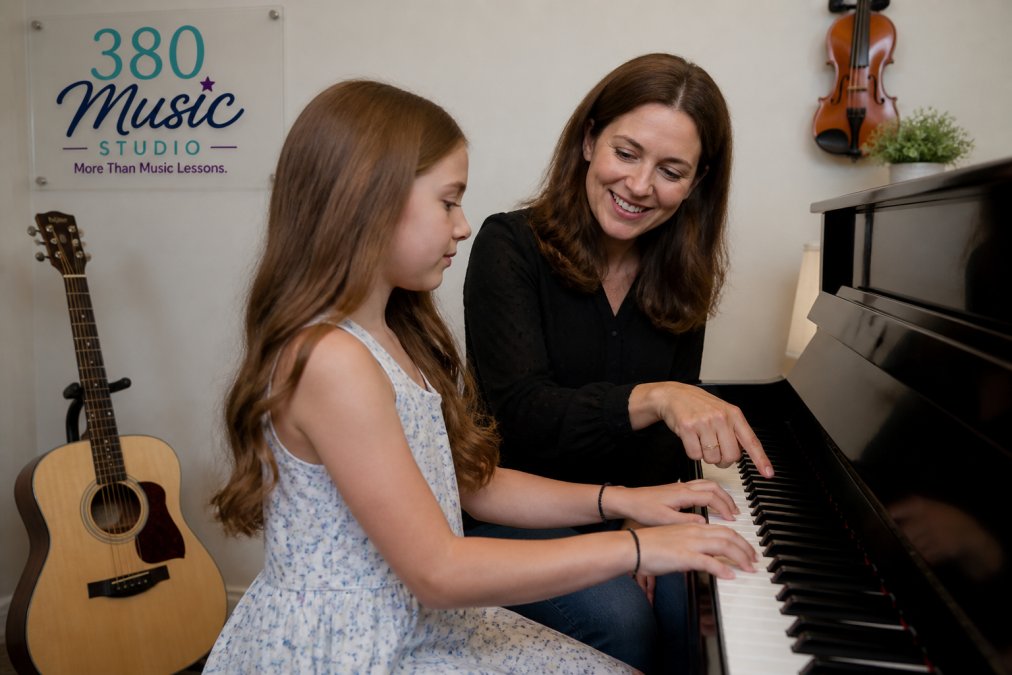
The best music lessons in Aubrey TX are built around the student, not a fixed program. At 380 Music Studio, we’ve taught along the 380 Corridor since 2010, and the difference we see most often isn’t the instrument or the method. It’s whether the teacher adapts to the person sitting across from them.
That distinction matters more than most families expect. A child who quit piano after a few months usually didn’t quit music. They quit a setup that never fit them.
So what actually separates a studio worth driving to from one that fades into the background? Three things: teachers who adjust to how each student learns, a schedule that works for real families, and a clear sense of progress you can see and hear. Below, we break down how to evaluate all three before you enroll.
How to Choose a Music Teacher for Beginners
Choosing a music teacher for beginners comes down to fit, not credentials alone. The right teacher reads how a student responds and adjusts pace, tone, and material accordingly. That’s harder to measure than a resume, but you’ll feel it in the first few minutes of a trial visit.
A common mistake is treating the first teacher you find as the only option. Ask questions. Watch how the teacher talks to your child. Notice whether they seem curious about the student or focused only on the lesson plan.
Questions to Ask Before You Enroll
Use this checklist when you visit any studio, including ours:
- How do you adapt lessons for a student who learns differently?
- Can we meet the specific teacher before committing?
- How do you measure progress beyond “they’re getting better”?
- What happens if my child needs a different pace?
- How do you handle a student who gets anxious or distracted?
The Benefits of Private Music Instruction for Kids
Private music instruction for kids builds more than musical skill. Students develop focus, patience, and the confidence that comes from working through something difficult with someone in their corner. Those benefits show up well beyond the instrument.
The National Association for Music Education has long noted that music study supports cognitive development, including memory and pattern recognition. The American Psychological Association has also published work connecting musical training to attention and self-regulation in children. In practice, this means a weekly lesson becomes a structured hour where a student learns to concentrate, recover from mistakes, and keep going.
What Parents Actually Notice First
Ask families a few months in, and the changes they describe tend to be specific rather than abstract:
- They finish things. A student who used to abandon a song at the first wrong note learns to loop back, slow down, and try again. That habit follows them into homework and chores.
- They perform under mild pressure. Playing for a teacher, then for a small group at a studio recital, teaches a child that being watched is survivable. That is the same muscle used for a class presentation or a first shift at a job.
- They hold a longer attention span. A lesson asks a student to stay with one task for a set stretch of time, with a person responding in real time. That back-and-forth is different from passively watching a screen.
- They hear themselves improve. Progress in music is audible. A student can play a piece in March that they could not play in January, and that evidence is hard to argue with.
Confidence, Focus, and Time Away From Screens
One of the quieter benefits is the break from screens. A lesson is a time of hands-on, in-the-room attention. Many parents tell us that alone is worth it.
Progress also builds resilience. When a student finally plays a chord progression that fought them for two weeks, they learn that effort pays off. That lesson travels to school, sports, and friendships. A teacher who knows the student can point to that moment out loud, which is what turns a good week into a lasting habit.
Instruments and Skill Levels We Teach Along the 380 Corridor
We teach piano, voice, guitar, bass guitar, drums, and violin, and we work with complete beginners through experienced players. Every student gets a plan shaped around their goals, whether that’s playing for fun, preparing for an audition, or building real technique.
Lessons are private and one-on-one, which means the teacher can move at exactly the right pace. A beginner-friendly approach for a young child looks nothing like the plan for a teen prepping an audition or an adult returning to an instrument after years away.
A Quick Guide to Choosing the Right Instrument
Most families arrive with a short list and a lot of questions. Here is how we usually talk through the options. None of these are rules, and a teacher will help you sort out what fits your student once you meet.
Piano is the most common starting point because the layout is visual: low notes on the left, high notes on the right, one key per pitch. That makes it easy for a student to see cause and effect. It also works well for kids who like to sit and tinker, and for adults who want to play songs they already know.
Voice suits students who sing constantly around the house and want to understand what they are doing. A teacher works on breath, pitch matching, and healthy habits from the first lesson, and the material is chosen around the songs the student actually enjoys.
Guitar tends to appeal to students who want to play along with music they already listen to. It is portable, and a beginner can often play a recognizable chord progression within the first few weeks, which keeps motivation high. Fingertip soreness is normal early on and fades.
Bass guitar is a good fit for students who like rhythm and want to be part of the groove rather than the melody. It rewards steady timing and listening, and it is often a natural second instrument for a guitar or drum student.
Drums draws students with a lot of physical energy and a strong sense of beat. A teacher starts with coordination and basic patterns, and the setup at the studio means volume is not a problem at home.
Violin rewards patience and ear training. It is a good match for students who like a challenge and enjoy the sound of a string instrument. Progress is gradual at first, then accelerates.
If your student is torn between two, that is a normal place to start. A trial visit is a low-pressure way to try one and see how it feels.

Lessons for Every Age, From Aubrey to Prosper and Little Elm
Students come to us from Aubrey, Union Park, Paloma Creek, Savannah, Prosper, Windsong Ranch, Hollyhock, Little Elm, Providence Village, Oak Point, Crossroads, and the 76227 zip code, plus families in West Frisco who don’t mind the short drive.
What to Expect From Your First Lessons and Trial Visit
Frequently Asked Questions
What should I look for when choosing a music studio in Aubrey?
Start with the teacher, not the building. Ask whether the studio matches instructors to each student’s personality and goals, whether lessons are one-on-one, and how progress is communicated to families. Visit in person if you can. A good studio on the 380 Corridor will welcome questions and offer a trial lesson so you can see the fit before committing. 380 Music Studio has served the area since 2010 and builds lessons around the individual student.
How much do private music lessons cost?
Tuition depends on lesson length, how often you meet, and the instrument, so it varies from studio to studio. Rather than quote a number here, contact 380 Music Studio directly for current rates and to ask about any enrollment terms. Ask upfront whether there are registration fees or long-term contracts, and how billing works month to month. A clear answer to those questions tells you a lot about how a studio treats families.
How do I know if my child is ready for music lessons?
There is no single age or sign that means a child is ready. Interest matters more than age: a child who sings along, taps rhythms, or asks about an instrument is showing you something. Teachers at 380 Music Studio adapt the pace and approach to each student, including young children and kids who need a gentler introduction, so the first few lessons are about building comfort as much as skill.
My child quit lessons before. What would be different this time?
Most kids who quit were working from a plan that did not fit them. At 380 Music Studio, the teacher shapes the repertoire, pace, and goals around what keeps that specific student engaged, whether that is a favorite song, a new instrument, or a different style. The personalized instruction ensures nothing moves forward until the student is ready. Families in Savannah, Paloma Creek, and Providence Village often start with a trial visit to test the fit.